





Italy’s World Cup Journey: From Glory to Missed Opportunities
The Triumph of 2006: Italy’s Last World Cup Victory
The 2006 FIFA World Cup, hosted by Germany, marked a significant chapter in the annals of Italian football. Italy’s national team, often referred to as the Azzurri, embarked on an extraordinary journey to clinch their fourth World Cup title. This campaign was characterized by resilience, tactical brilliance, and an innate ability to rise to the occasion during crucial moments.
Italy began their World Cup adventure in the group stage, where they were placed in Group E alongside Ghana, the United States, and the Czech Republic. The Azzurri displayed their depth of talent as they secured their place in the knockout stages, with standout performances from players such as Francesco Totti and Gianluigi Buffon. One of the most notable group stage matches was their clash against the Czech Republic, where Italy came back from a goal down to claim a 2-0 victory, showcasing their indomitable spirit.
As Italy progressed to the knockout rounds, they faced challenges that tested their character. The quarterfinal match against Ukraine saw Fabio Grosso score a stunning goal, propelling Italy into the semifinals. Facing Germany in a thrilling semifinal, Italy prevailed after extra time, thanks to another iconic goal from Grosso and a late strike by Alessandro Del Piero. This match exemplified Italy’s tactical prowess, with head coach Marcello Lippi orchestrating a strategy that maximized the team’s strengths.
The final against France was one for the history books, marked by a dramatic penalty shootout following a tense 1-1 draw. Zinedine Zidane’s early penalty was equalized by Marco Materazzi’s header. Ultimately, Italy triumphed in the shootout, with Fabio Grosso successfully converting the decisive penalty. The victory not only solidified Italy’s place in World Cup history but also brought a wave of euphoria across the nation, uniting fans in celebration after years of disappointments on the global stage.
This triumph significantly impacted Italian sports culture, reigniting national pride and establishing a legacy that continues to inspire future generations. The success of the 2006 World Cup serves as a reminder of the heights that Italian football can achieve, fostering aspirations of future glories on the world stage.
The Unraveling: Brazil 2014 and the Early Exit
The 2014 FIFA World Cup, held in Brazil, marked a significant moment in Italy’s football history, characterized by an unexpected early exit that surprised fans and analysts alike. The Italian team, known for its rich World Cup legacy, was drawn into Group D alongside Uruguay, England, and Costa Rica. Unfortunately, their performance did not reflect the high expectations surrounding their participation in this prestigious tournament.
Italy’s campaign began with a tightly contested match against England, where they managed to secure a 2-1 victory. However, the following matches proved to be detrimental to their advancement. A critical aspect of Italy’s unraveling was the subsequent match against Costa Rica. The Azzurri failed to capitalize on scoring opportunities, resulting in a disappointing 0-1 defeat. The lack of goal-scoring effectiveness was compounded by tactical decisions that appeared to hinder the team’s offensive play. Coach Cesare Prandelli’s strategy came under scrutiny as fans questioned whether the formation and lineup choices adequately utilized the players’ strengths.
Moreover, injuries played a significant role in undermining Italy’s efforts during the tournament. Key players, including Andrea Pirlo and Thiago Motta, faced fitness issues that severely impacted the team’s cohesion. Without their influential presence on the pitch, Italy struggled to maintain the tactical discipline and creativity necessary to penetrate opposing defenses. The situation culminated in a must-win match against Uruguay, where Italy succumbed to a 0-1 defeat, resulting in an early exit from the tournament.
The implications of this performance were profound, as Italy’s World Cup aspirations appeared to be in disarray. The 2014 experience prompted renewed discussions about the need for restructuring within the national team and raised questions about Italy’s competitive standing in international football. The harsh exit served as a wake-up call, highlighting the necessity for a coherent approach in both tactics and player selection in future tournaments.
A Series of Missed Chances: 2018 and 2022 World Cups
Italy’s football history is often celebrated for its remarkable achievements, but the nation faced unexpected setbacks in the 2018 and 2022 World Cups. The first significant blow came during the qualification phase for the 2018 tournament in Russia. The Italian national team, despite being one of the sport’s powerhouses, found itself in a challenging playoff against Sweden. The two-legged match proved to be a nightmare, as Italy was unable to secure a victory, ultimately losing 1-0 on aggregate. This defeat marked a pivotal moment, as it was the first time Italy failed to qualify for the World Cup since 1958, leading to widespread shock and disappointment across the nation.
The aftermath of the 2018 failure prompted a major reevaluation of Italy’s footballing structure, which many believed had started to stagnate. Football enthusiasts and analysts pointed towards a need for modernization in coaching methods, player development, and strategic approach at all levels of the game. However, these changes did not translate into immediate success, and when the qualification process for the 2022 World Cup commenced, hope once again began to build within the Italian football community.
Unfortunately, the 2022 World Cup in Qatar was marked by further disappointment. Italy, despite having a roster filled with talent, faced a shocking loss to North Macedonia in the playoff semifinals. A single late goal from North Macedonia shattered any dreams of World Cup participation, leaving Italy out of consecutive tournaments for the first time in their illustrious footballing history. This continual absence raises critical questions about the factors contributing to these failures, including tactical decisions, player selection, and broader trends in youth development. As Italy reflects on this series of missed opportunities, the focus will likely shift to understanding how such historic struggles came to pass, and what measures are necessary to restore their footballing legacy.
Looking Ahead: The 2026 World Cup and Italy’s Future
Italy’s national football team has experienced a tumultuous journey in international competition over the past few years, culminating in their notable absence from the 2022 FIFA World Cup. As we look forward to the 2026 World Cup, co-hosted by the United States, Canada, and Mexico, it is essential to reflect on the current standing of the team and the potential pathways for their revival.
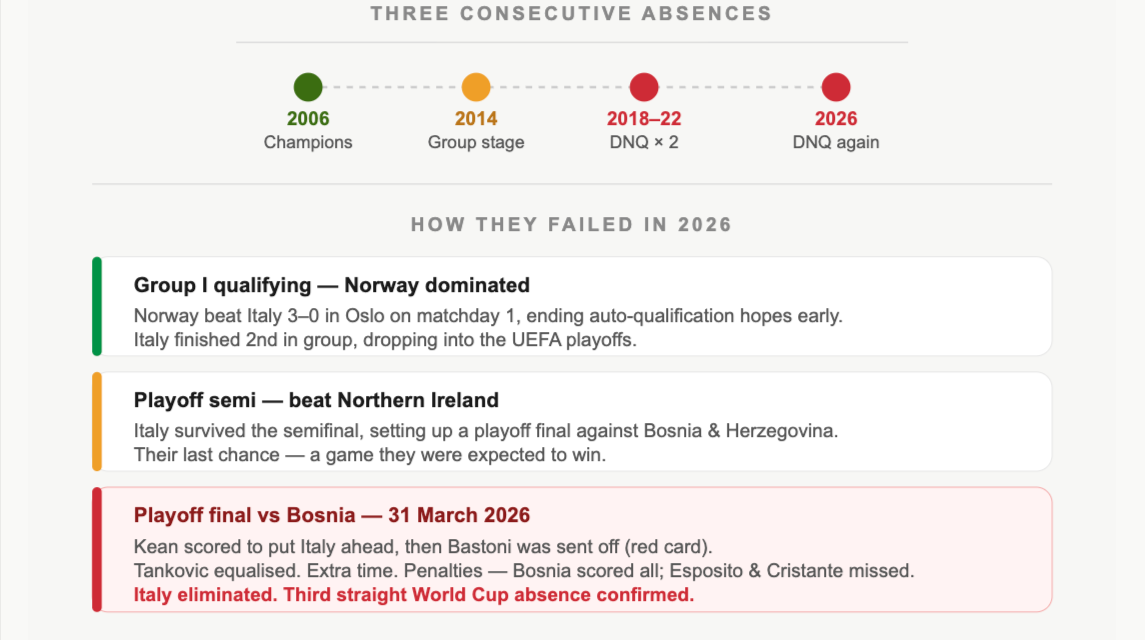
The recent playoff loss to Bosnia has raised concerns amongst fans and analysts alike about the future of Italian football. As the nation grapples with this disappointment, discussions about rebuilding the national team have become increasingly pertinent. The emphasis on nurturing young talent and adopting modern coaching techniques will be crucial in redefining Italy’s identity on the global stage.
Moreover, the collaboration between established players and emerging stars could foster a dynamic team capable of competing at the highest level. Italy has a rich history of cultivating world-class talent, and reviving this tradition is essential for reclaiming past glory. Thus, there must be a concerted effort from the Italian Football Federation to invest in development programs and scouting networks to ensure a steady influx of quality players.
The 2026 World Cup provides an opportune moment for Italy to reassess its strategies and vision for the future. The broader context of international football continues to evolve, and Italy must adapt to these changes if it hopes to succeed. With the united spirit shared by fans and the football community, there remains hope that Italy can overcome its recent setbacks and make a formidable return to the world stage.
Ultimately, the road to the 2026 World Cup is an opportunity for the Italian national team not only to heal from past disappointments but also to lay the groundwork for sustained success in international football. With determination and strategic foresight, Italy can aim to reestablish itself as a powerhouse in the world of competition much like it has in previous decades.



Wow, what a FIFA start